Preloop and the EU AI Act: our compliance brief, with the reasoning shown
People who evaluate Preloop in Europe ask two questions sooner or later. Is Preloop itself an AI system under the EU AI Act? And what does it give us for our own obligations once agents act on our behalf?
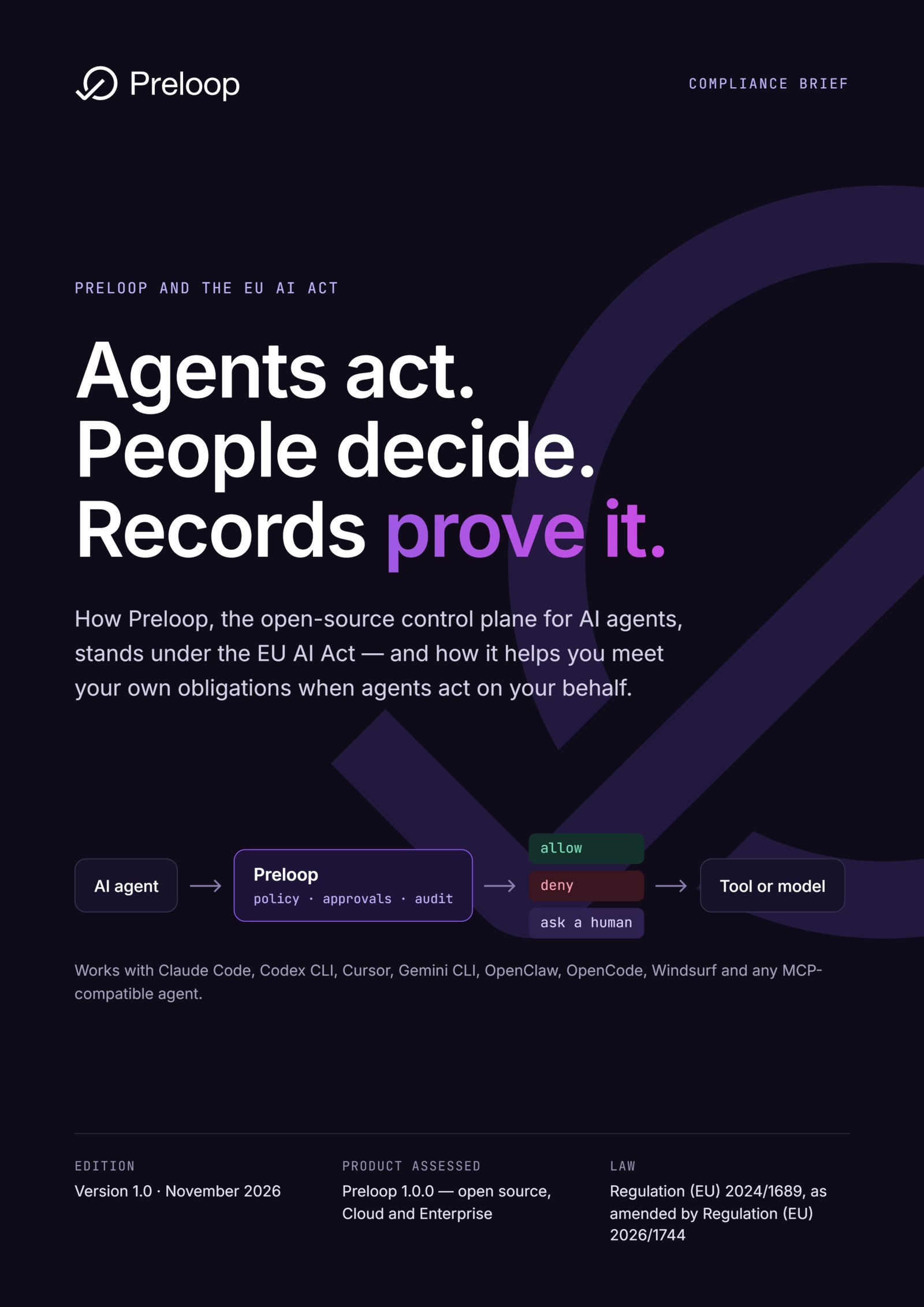
We wrote the answers down in a nine-page brief. It assesses Preloop 1.0.0 against Regulation (EU) 2024/1689 as amended by Regulation (EU) 2026/1744. We asked Law & Tech, Attorneys at Law (lawandtech.eu) to review the legal content, and the brief changed a good deal because of that review.
The whole brief is below. You can also download the PDF.
What it says, in short
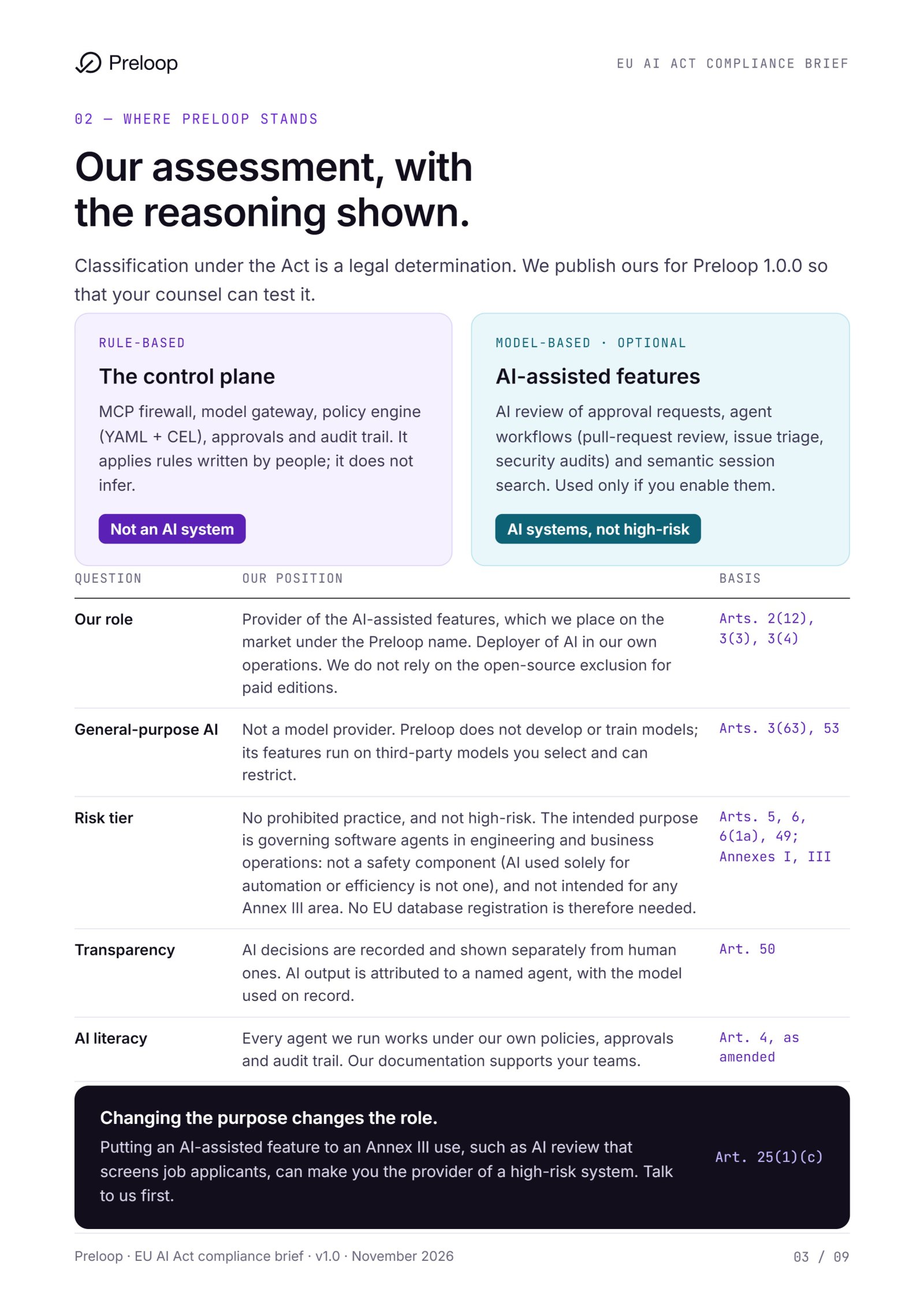
Where Preloop stands. The core control plane (MCP firewall, model gateway, policy engine, approvals, audit trail) applies rules that people write. It does not infer, so we do not consider it an AI system. The optional AI-assisted features are AI systems: AI review of approval requests, agent workflows such as pull request review, and semantic session search. We provide them as AI systems that are not high-risk, on models you choose, with AI decisions labelled and a person able to override. The brief gives the articles behind each position so your counsel can test it.
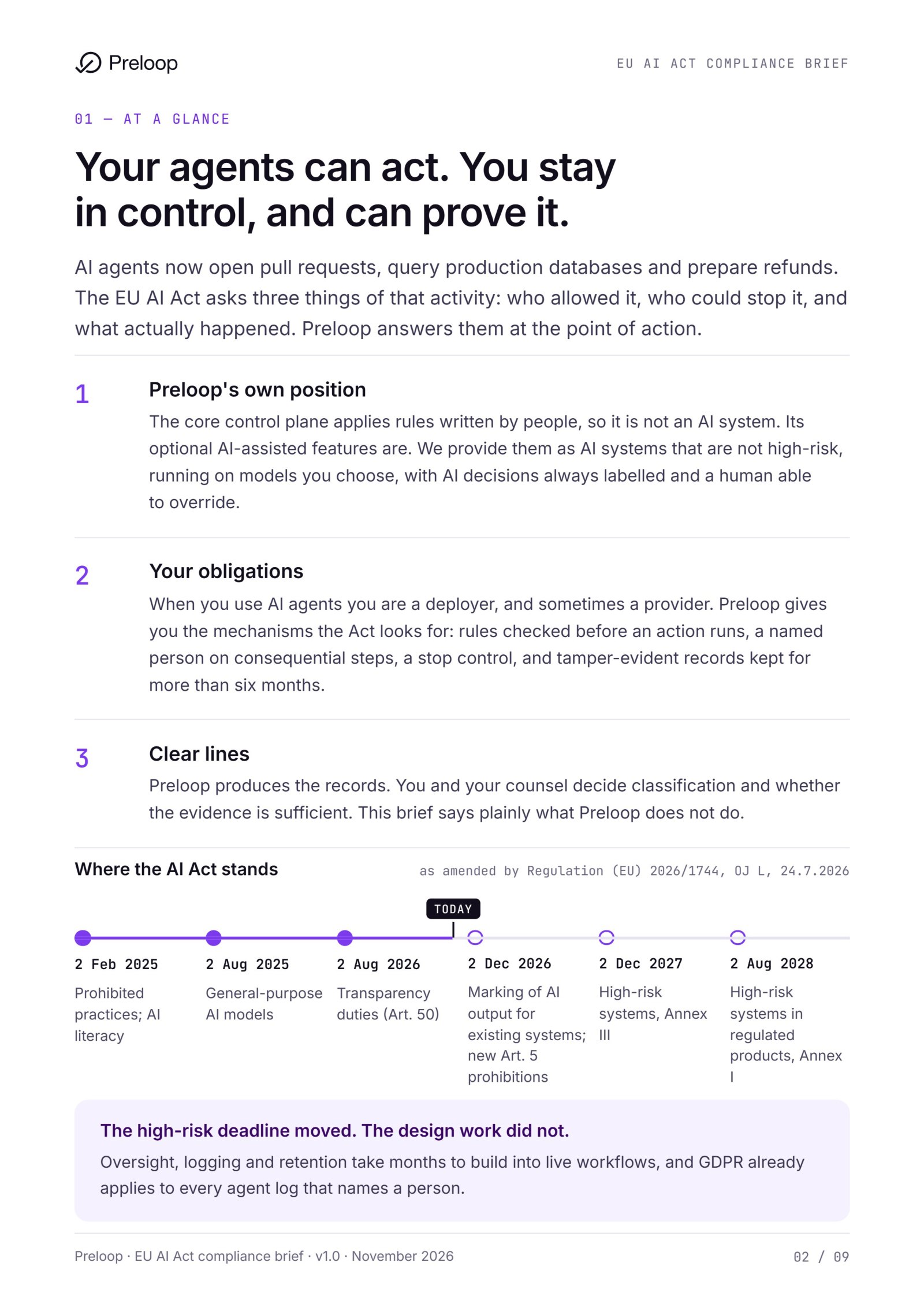
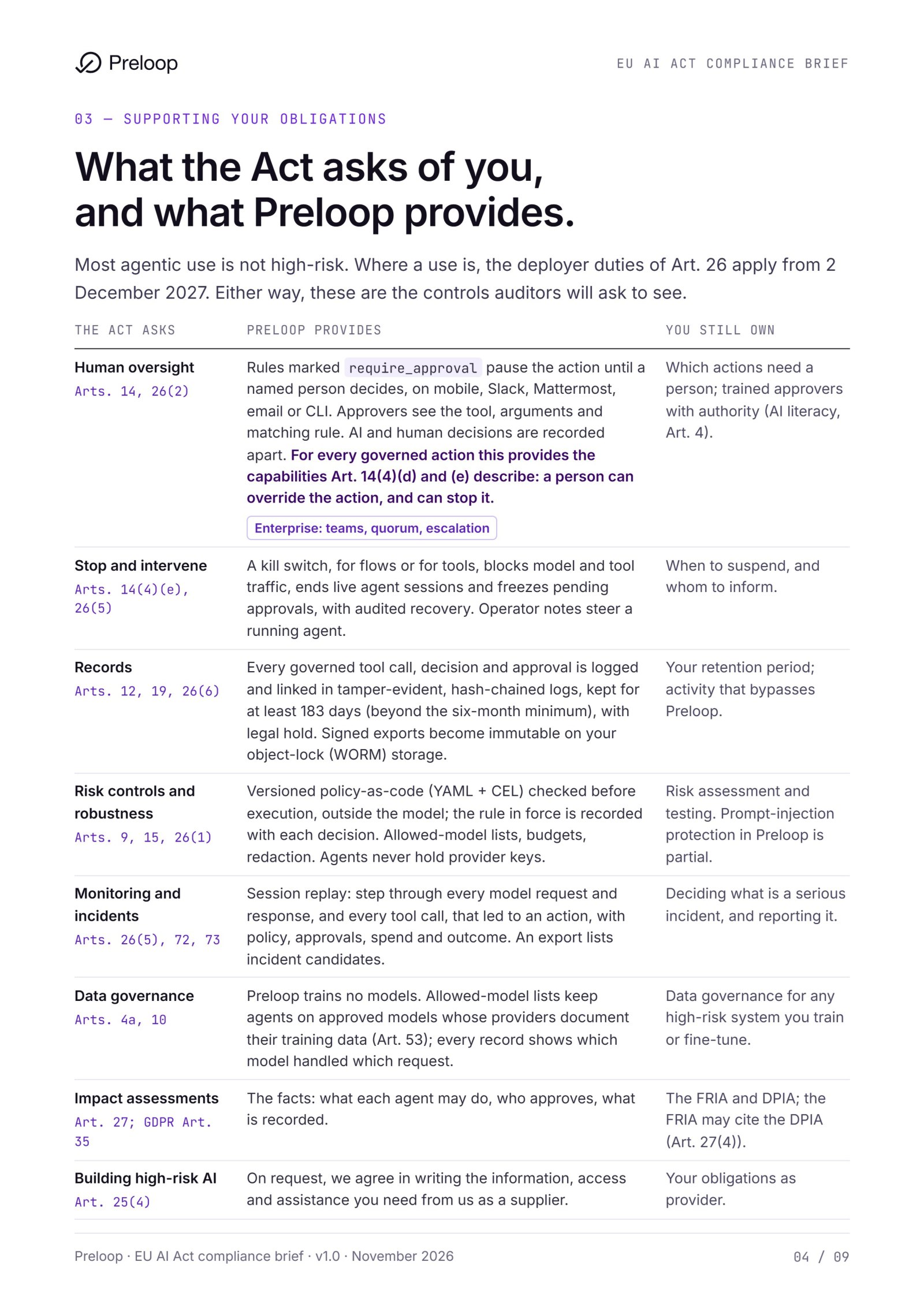
What you get for your own obligations. If you use AI agents you are a deployer, and sometimes a provider. The brief maps the controls an auditor will ask to see to what Preloop provides and to what you still own:
- Rules checked before an action runs, outside the model.
- A named person on the steps you mark as consequential, with the tool, the arguments and the matching rule in view.
- A kill switch that blocks model and tool traffic and ends live sessions.
- Hash-chained records kept for at least 183 days, with legal hold and signed exports that anyone can verify without us.
Where the dates are. The July 2026 amendment moved the high-risk deadlines: 2 December 2027 for Annex III systems and 2 August 2028 for high-risk systems in regulated products. The transparency duties of Article 50 have applied since 2 August 2026. Oversight, logging and retention take months to build into live workflows, so the later date is not a reason to wait.
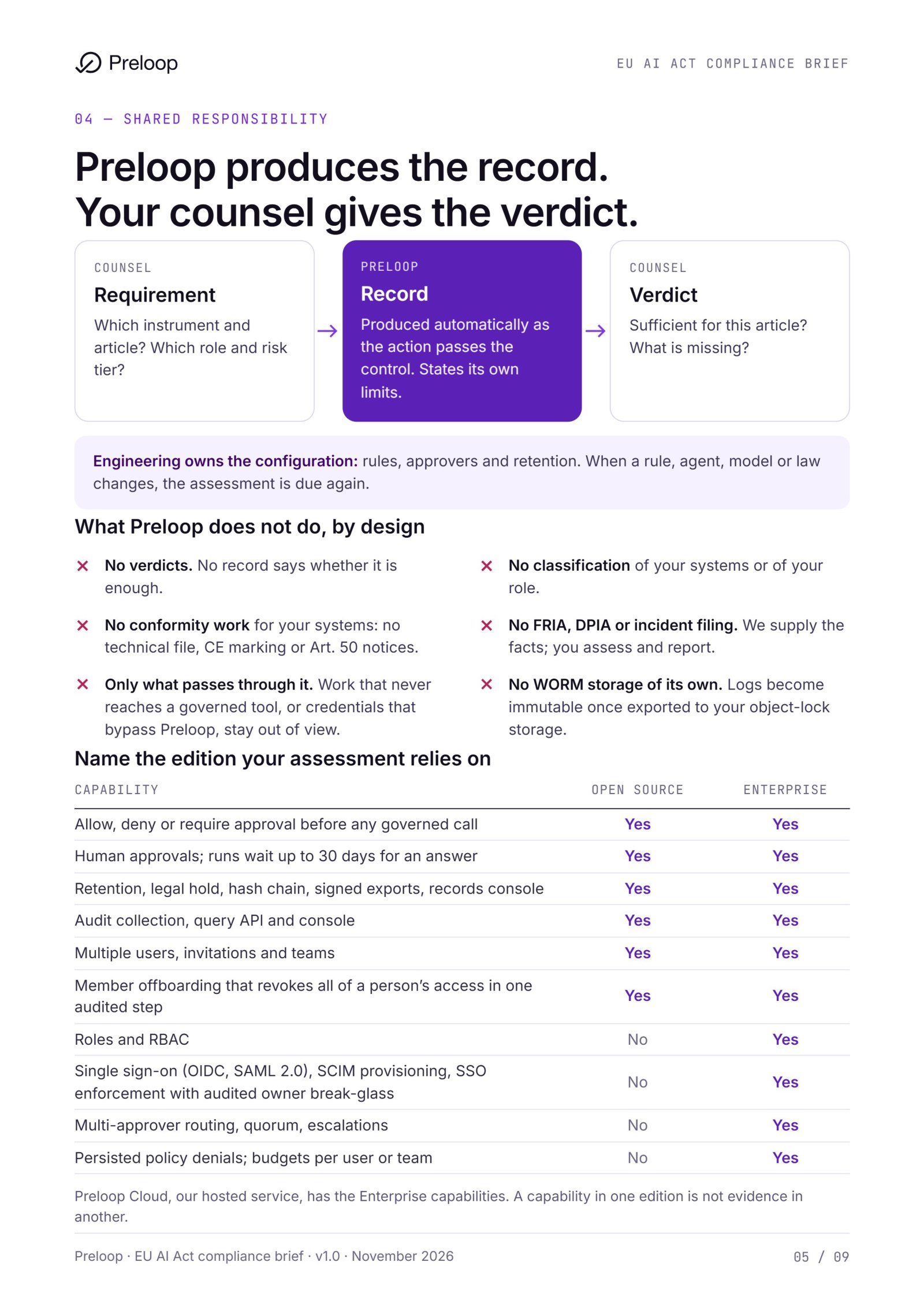
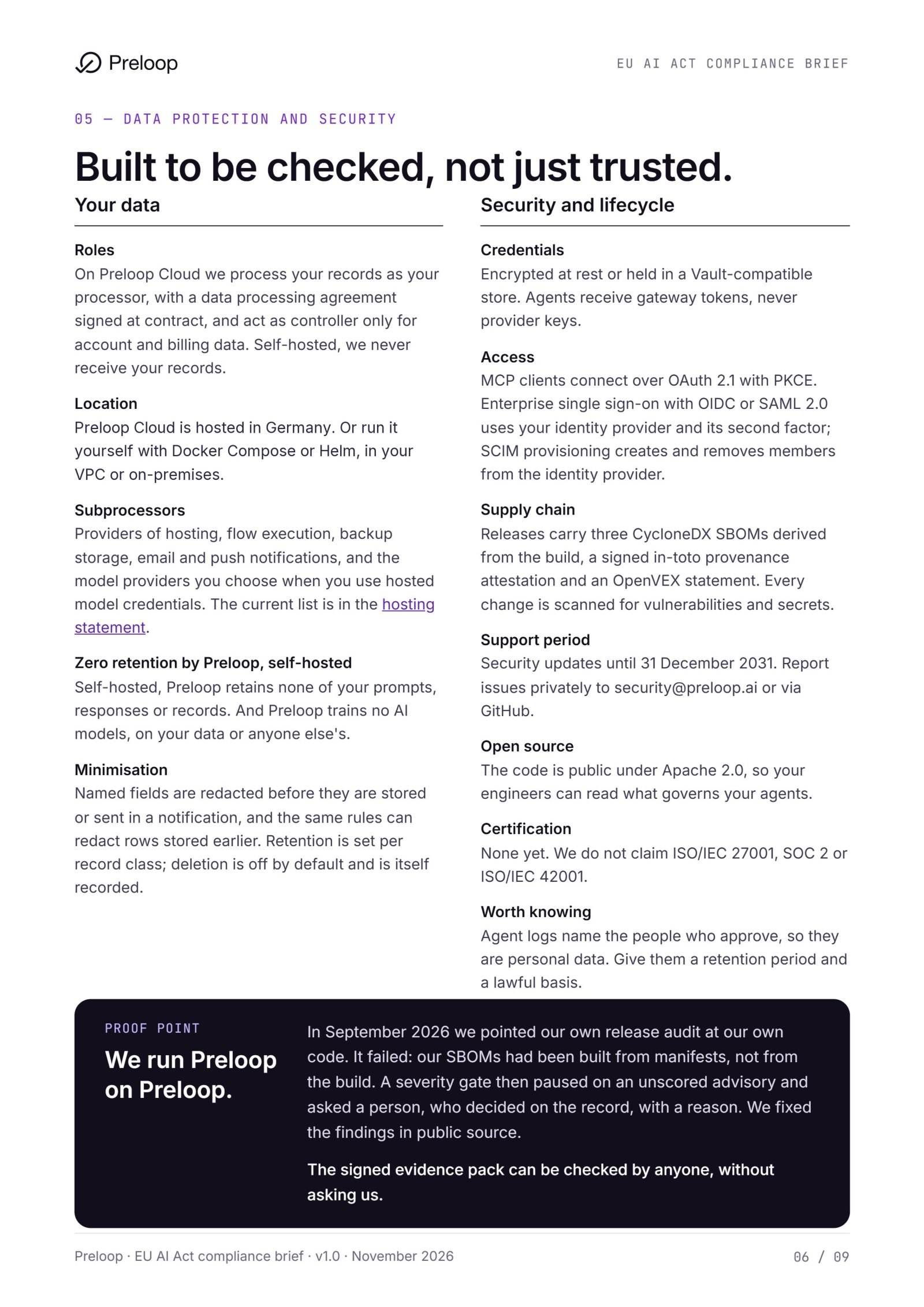
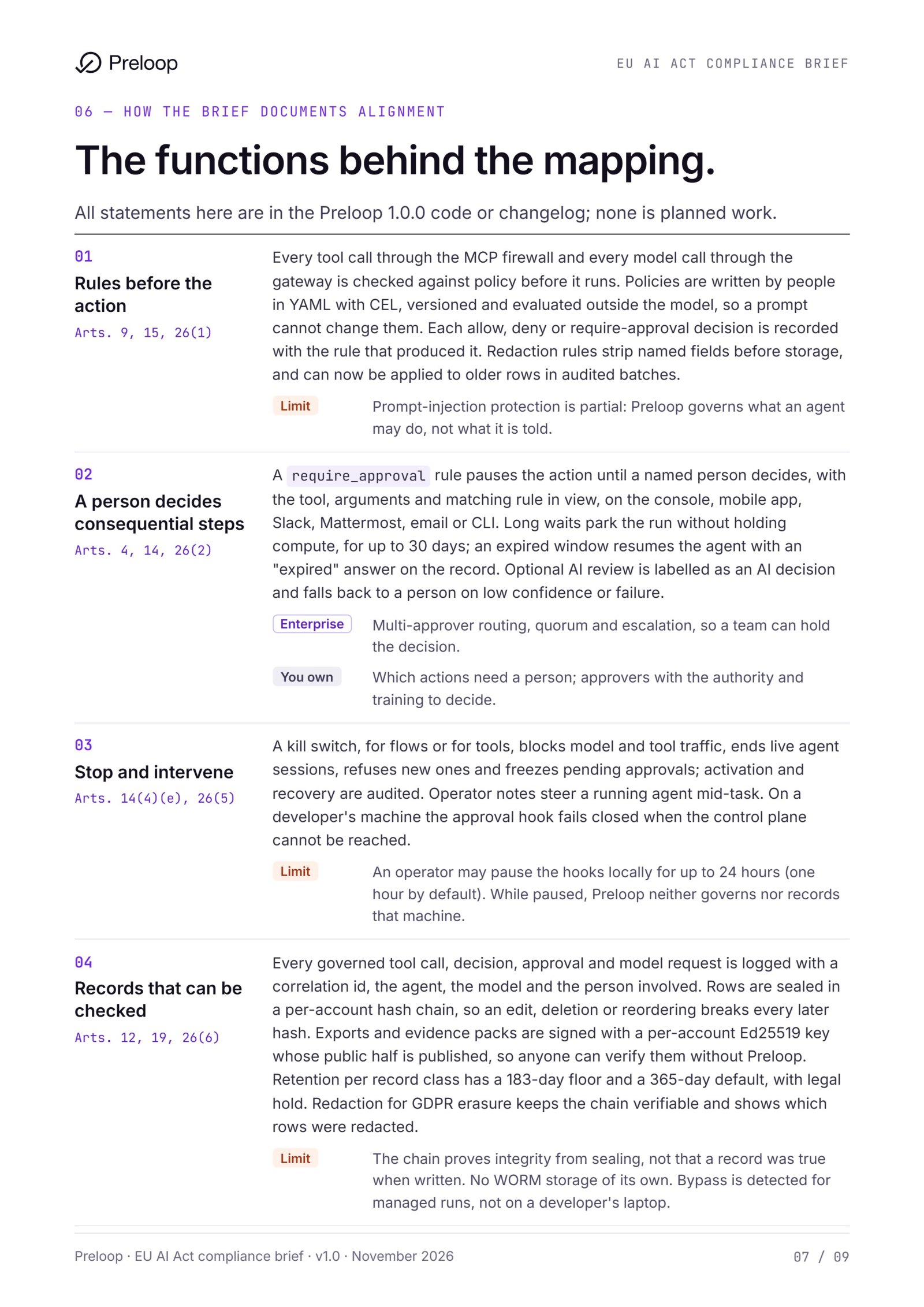
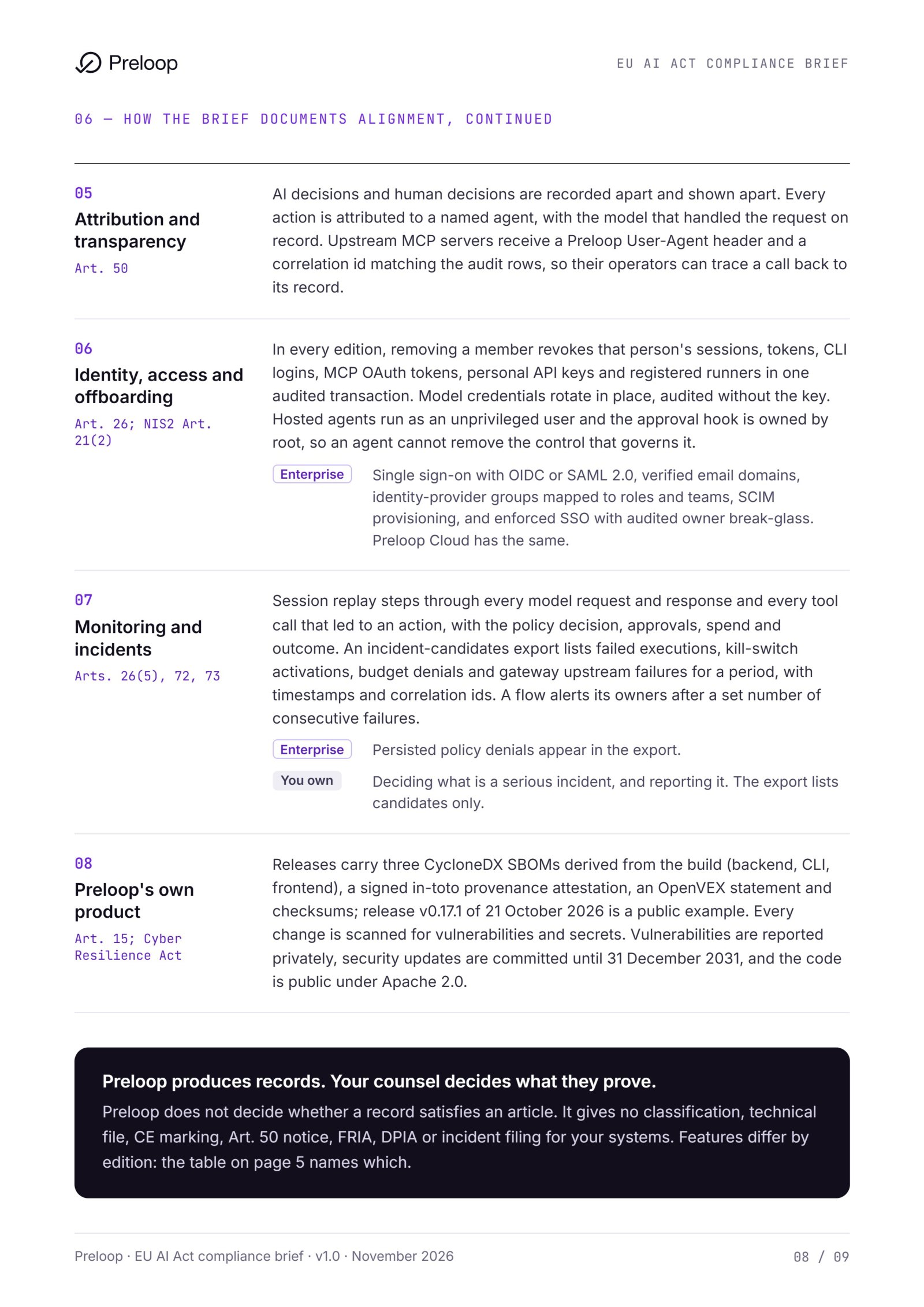
What Preloop does not do. This is the section I would read first. Preloop produces records. It does not classify your systems or your role, and it does not say whether a record is enough for an article. It does not write your FRIA or DPIA or file your incidents. It sees only what passes through it. Prompt-injection protection is partial. We hold no ISO/IEC 27001, SOC 2 or ISO/IEC 42001 certification. Section 06 of the brief lists a limit next to each function.
The brief

The documents behind it
The last page lists what your counsel and procurement can ask for. All of it is public:
- Hosting and subprocessors for Preloop Cloud. This page is the current list of locations and third parties, and it is the one to rely on.
- A sample signed evidence pack that you can verify without asking us.
- The AI Act readiness page, which maps articles to records.
- The source, under Apache 2.0, at github.com/preloop/preloop.
The brief describes Preloop 1.0.0, which we released on 8 November. Features differ by edition, and the table on page 5 names which.
How to use it
Give it to your counsel and ask them to argue with page 3. If they disagree with our classification, I want to hear it: dimitris@preloop.ai.
Then try the exercise on the last page. Pick one consequential action that an agent takes in your company, write the rule for it, and ask someone who did not watch to rebuild what happened from the records.
This post and the brief are general information. They are not legal advice, a certification or a conformity assessment. Your obligations depend on your role, use case and sector.